This is the question we are asked before every commission, and the one people most often get wrong, usually by being too hard on their own photographs. They apologise for the lighting. They worry the file is too small. They rule out the picture they actually love because a cousin's elbow is in the frame.
Almost none of that matters. Here is what does.
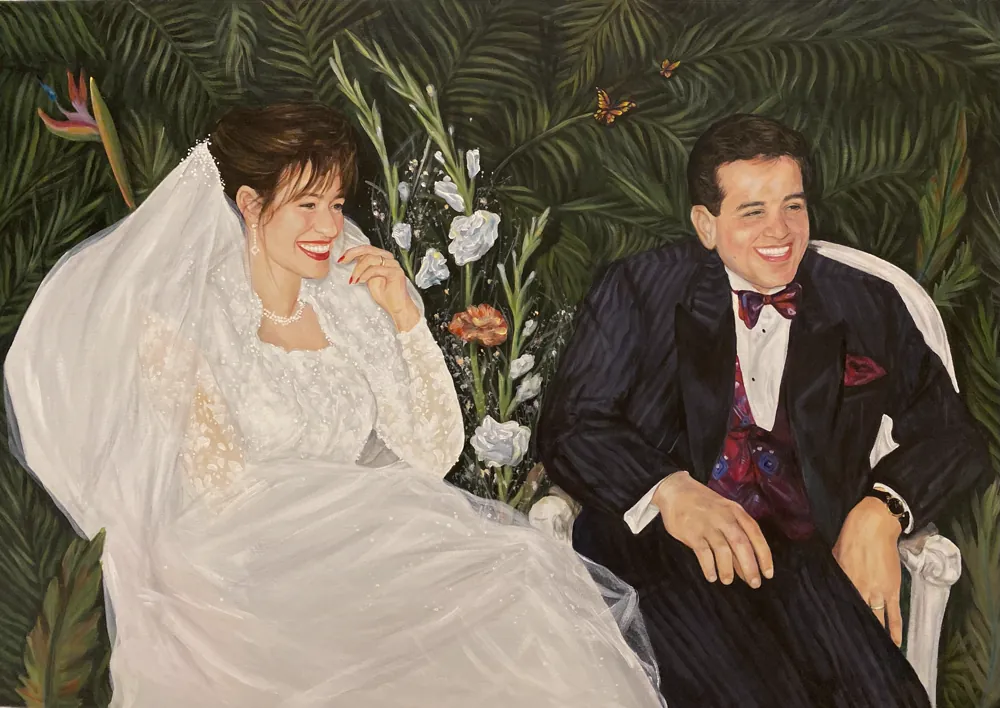
Start with the expression. Everything else is negotiable.
There is exactly one thing in a photograph that a painter cannot change without losing you: the expression.
A background can be replaced. Clothing can be corrected, a crooked tie straightened, a stray guest removed. Colour casts can be neutralised, harsh flash softened, a cluttered venue simplified into something calm. All of that is ordinary studio work.
But the painting is the particular way one of you is looking at the other: the half-second before a laugh, the slight tilt of the head. Alter it and you have a competent portrait of two strangers who resemble you.
The single most useful instruction we can give you: choose the photograph where you look most like yourselves, not the one that is technically best. We can fix a bad background. We cannot invent the moment.
The four things that actually matter
1. Are the eyes legible?
Open the image and zoom in on the faces until they fill your screen. Can you still see the eyes clearly: their shape, and where they are looking? If yes, you almost certainly have a workable photograph, whatever else is wrong with it. If the eyes dissolve into a smudge, no amount of skill will put them back, because the information simply is not there.
2. Is there a clear direction of light?
Painting is largely the description of how light falls on a form. A photograph with a discernible light source, such as window light, warm evening sun, or a lamp to one side, gives a painter structure to work with: a lit cheek, a shadowed jaw, depth.
The hardest photographs to paint are the flattest ones: direct on-camera flash in a dark hall, which erases shadow and leaves faces looking pressed against glass. Such photographs can still be painted; the light simply has to be reconstructed, which is an interpretation, and worth discussing before we begin.
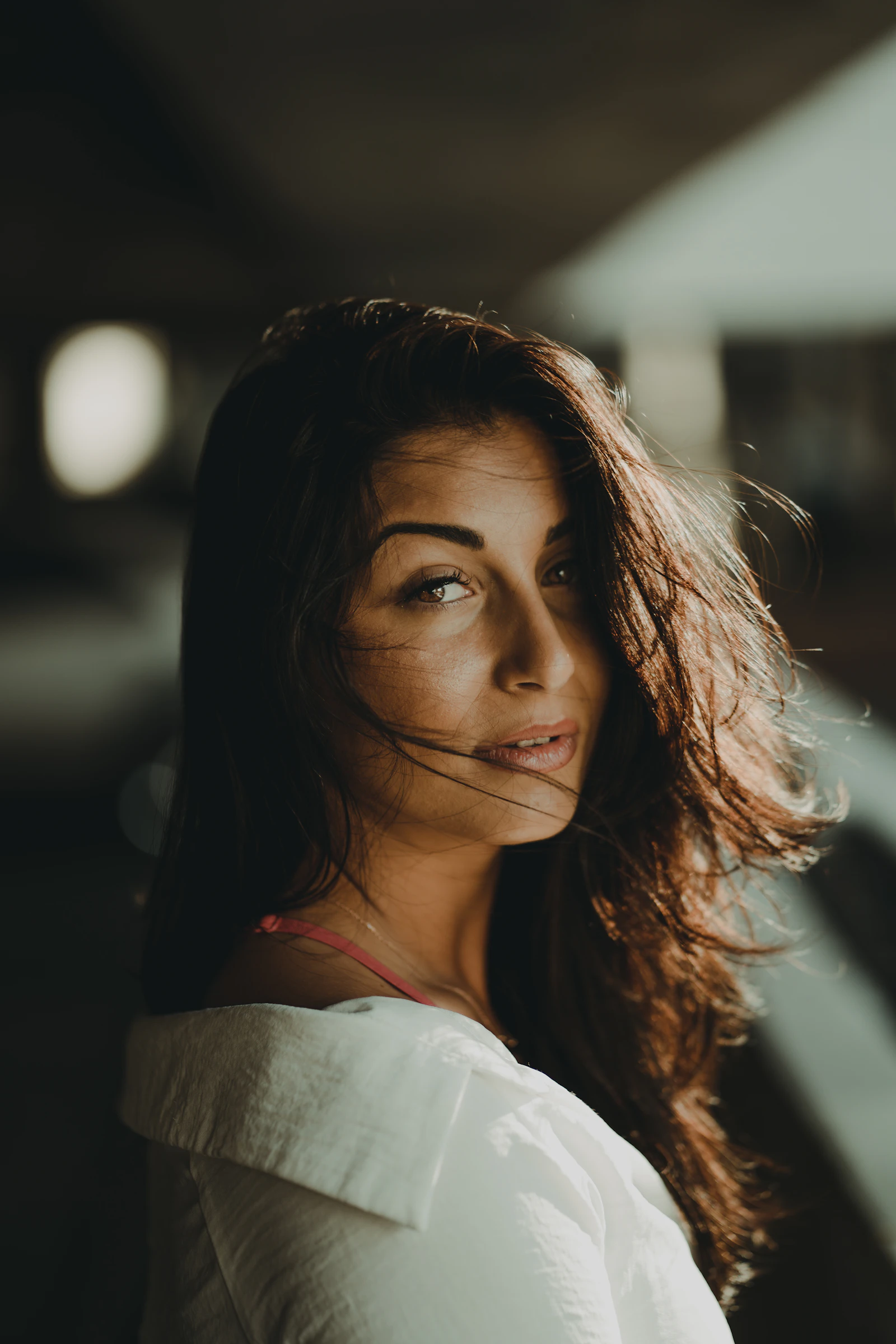
3. Was it taken roughly at eye level?
A camera held above the subjects enlarges foreheads and shrinks jaws; one held low does the reverse. In a photograph you barely register it. Enlarged to ninety centimetres of canvas and hung on a wall, you register it every day. Photographs taken at roughly the couple's own eye level almost always paint better.
4. Is the moment actually yours?
The formal, chin-up, everyone-looking-at-the-camera photograph is often the one families choose. It is also, frequently, the least interesting painting, because it is a picture of two people being photographed.
The image where the bride is laughing at something off-frame, or the groom is watching her rather than the lens, tends to produce a portrait people stop in front of years later. Candour survives translation into paint. Posing does not.
What does not matter (and what people wrongly rule out)
- The background. Genuinely. A hotel ballroom carpet, an exit sign, a catering trolley: all of it can go. The Grand tier exists partly to rebuild settings entirely.
- Other people in the frame. A stray guest, a photographer's arm, half a bridesmaid. Removable.
- Age of the photograph. Faded prints and scanned film are frequently better source material than a modern phone photo, because film handled skin and shadow gracefully.
- Resolution, up to a point. A painting is an interpretation, not an enlargement. We are not upsampling pixels; we are re-describing a face in paint. A modest file with legible faces beats an enormous one where you are small in the frame.
The traps
Four recurring problems, in rough order of how often they catch people out.
The cropped group shot
You love the big family photograph, so you crop the two of you out of the middle of it. But you were forty people wide in that frame, which means your faces occupy a few hundred pixels and the eyes are gone. This is the most common way a good photograph becomes an unusable one.
Portrait-mode blur
Phone portrait modes fake shallow depth of field by detecting an edge and blurring everything behind it. Phones are poor at edges made of hair, lace and veil, precisely the edges a wedding photograph is full of. The result often shows veil dissolving into background, or a halo of sharpness around a shoulder. Where possible, send the standard version rather than the portrait-mode one, and send the original file rather than a screenshot or a WhatsApp forward, both of which discard detail.
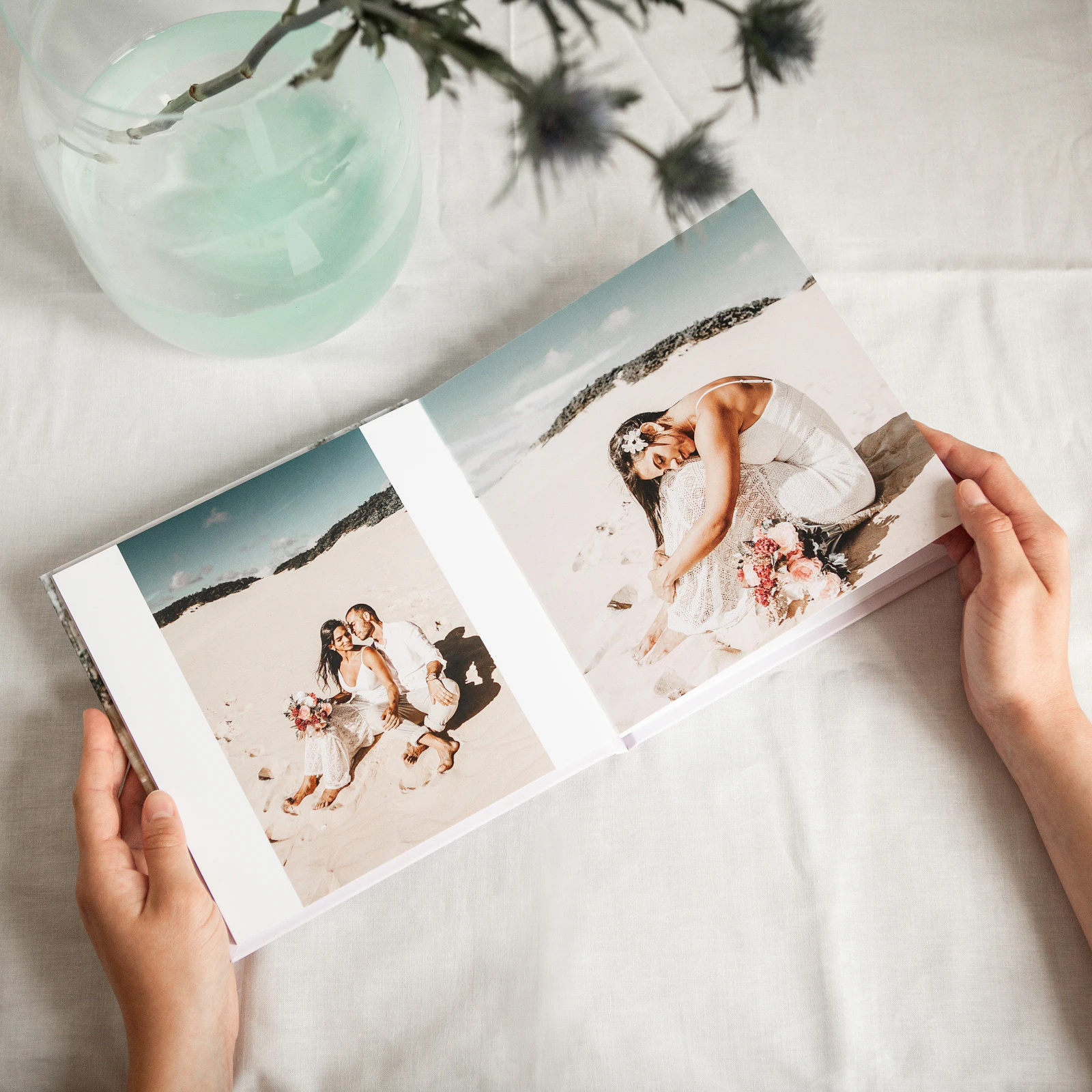
Heavy filters and beauty smoothing
Skin-smoothing removes exactly the structure a painter reads a face by: the transitions between planes, the shadow under a cheekbone. A filtered photograph gives us a mask rather than a face. If you have the unedited original, always send that too.
Only one of you looks right
Common, and solvable: if the two best expressions live in two different frames, send both. Building a composition from more than one photograph is included at the Grand tier and in bespoke commissions.
Choosing for the shape of the canvas
A tall, vertical photograph of the two of you standing suits a vertical canvas of 40 × 60 cm or 70 × 90 cm. A wide photograph, or one where the setting genuinely matters, wants a larger or landscape format. It is worth deciding roughly where the painting will hang before choosing the image, because the wall often chooses the crop for you.
The short version
If you only remember one paragraph, remember this one.
- Zoom in. If you can see the eyes clearly, the photograph is probably usable.
- Pick the expression that is most you, not the one that is most correct.
- Prefer a clear direction of light over flat flash.
- Prefer eye level over shot-from-above.
- Ignore the background, the guests, the clutter and the age of the picture.
- Send the original file, not a screenshot, not a WhatsApp forward, not the portrait-mode version.
- If you cannot decide, send two or three. Choosing is part of our job.
And if you are still unsure whether a painting is the right object at all, as opposed to a very good print, that is a fair question. We have answered it honestly in hand-painted portrait vs. canvas print. If you already know you want one, the guide to commissioning a wedding portrait in Dubai covers sizes, timings and cost.
Not sure which photograph to send?
Send two or three and we will tell you, honestly, which one will make the better painting, and why.