Almost everyone who writes to us already has the photographs. Hundreds of them, taken by someone very good. So the question is rarely whether the day was captured. It is what to do with it now.
This is our honest answer, written by people who paint for a living and who also love photographs.
What a photograph does, and does beautifully
A photograph is an extraordinary thing. In a fraction of a second it records the light exactly as it fell: the precise colour of the sky at seven in the evening, the exact way her veil lifted, the guest laughing at the edge of the frame who nobody noticed at the time. No painter can match that accuracy, and none should try.
It is also the truest record you will ever have of what the day actually looked like. Keep the photographs. Print the ones you love. They will tell your children things a painting never can.
And a good print really does last
There is a story people tell about prints fading, and we would rather not repeat it, because as a blanket claim it is simply not true any more. A modern pigment print on good canvas, framed and kept out of direct sunlight, will still look like itself in a hundred years and more. That is the honest position, and we are glad it is the honest position. A beautiful print of a photograph you love is a fine thing to hang, and if that is what you want, you should have it.
So the case for a painting cannot rest on permanence, and we are not going to pretend it does. It rests on something else entirely, which is more interesting anyway.
Where a painting begins
A photograph reproduces. A painting interprets. That single sentence is the whole of it, and everything below is just what it means in practice.
When a camera made your photograph, it made no decisions about you. It could not. It recorded the ballroom carpet with exactly the same care it gave your face, because it has no way of knowing which one you will still care about in thirty years.
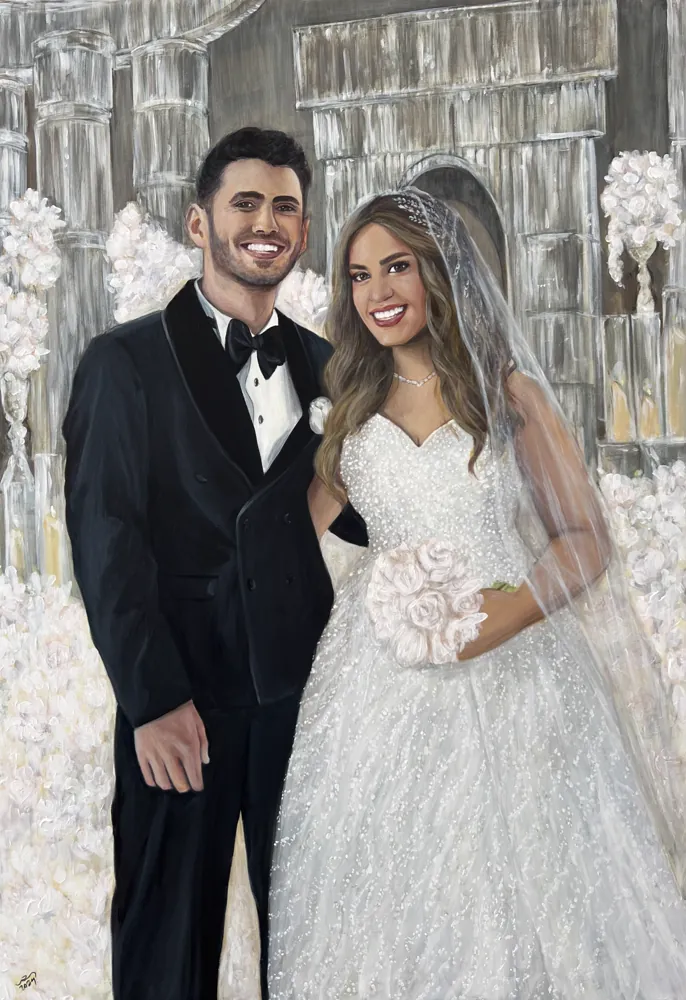
A painter knows. Over the weeks a portrait takes, someone is making thousands of small choices on your behalf: what to bring forward and what to let fall quietly away, where to sharpen an edge and where to soften it, how warm her skin truly looked in that light rather than how the sensor happened to render it. The carpet goes. Her expression stays, and is given room to breathe.
What a painting can do that a photograph cannot
Four things, in the order people tend to discover them.
- It can leave things out. The exit sign above your heads. The catering trolley. The stranger's arm across the frame. A print will preserve all of it faithfully, at whatever size you choose, for as long as it hangs. A painting simply lets it go, and no one who sees the finished piece will ever know it was there.
- It can rebuild the room. A setting composed the way the evening felt rather than the way it photographed. A background made calm. A scene assembled from two frames, so that the light of one and the moment of another can finally be in the same picture.
- It can work from a photograph that could never be printed. A small, grainy, thirty-year-old scan enlarges badly: a print magnifies every flaw in it. A painting does not enlarge the photograph at all. It re-describes the face. Some of the most moving commissions we take begin with the worst photographs, which is why choosing the right one matters far more than the size of the file.
- It can hold more than one day. A couple as they were, and a family that grew afterwards. Portraits are not confined to the moment the shutter opened.
The surface itself
This is the part nobody anticipates and everybody mentions afterwards.
Paint has physical relief. There are ridges where the brush was loaded and thin passages where the weave of the canvas shows through, and light moves across all of it differently as the sun crosses the room and the lamps come on in the evening. A painting is quietly a different object at breakfast than it is at dinner. It is not a flat image of a thing. It is a thing.
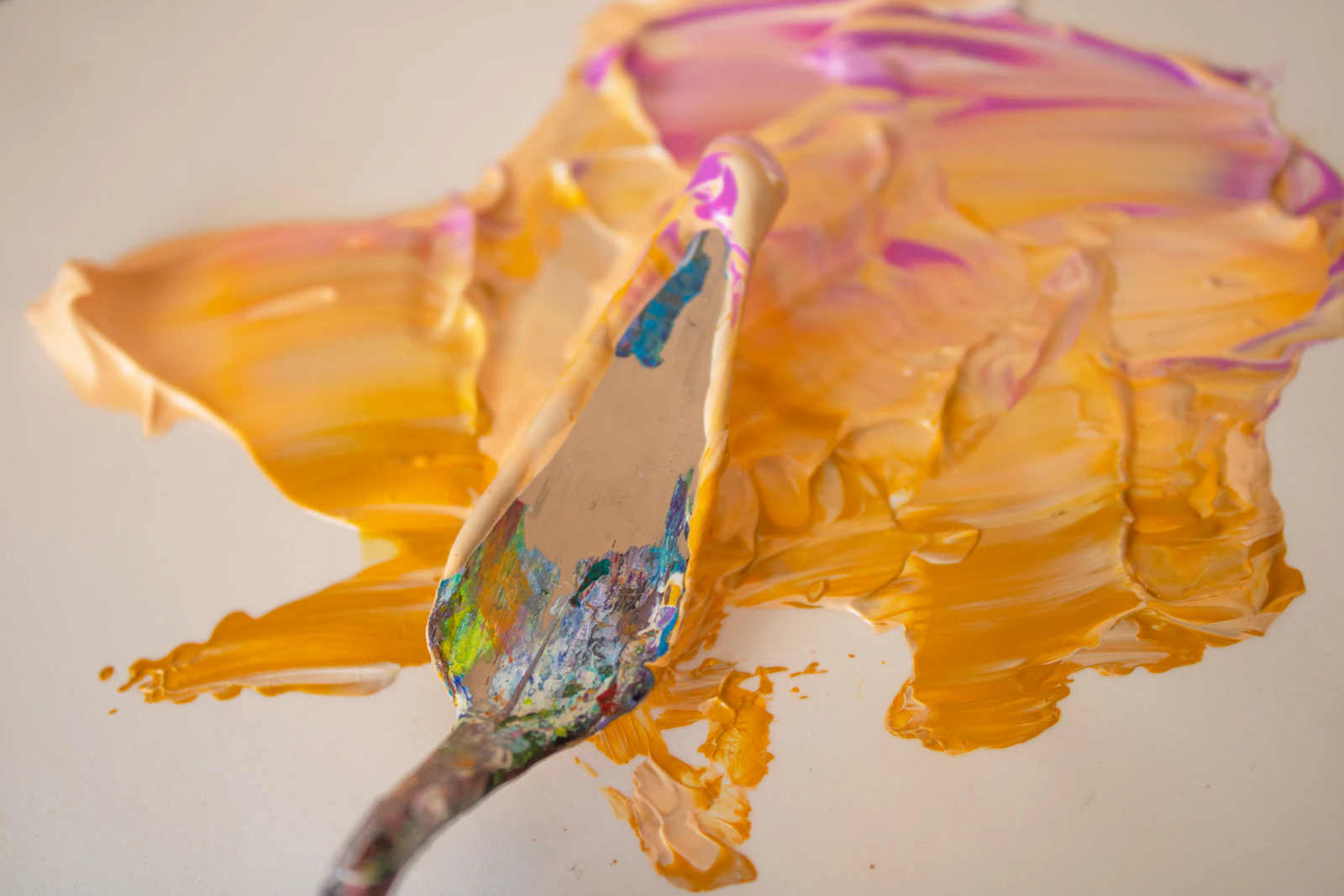
You cannot see this in a photograph of a painting, which is an irony we have made our peace with. It is why people stop in front of the real one.
One of one
A print is an instance. If it is damaged you order another, and the new one is identical, which is genuinely useful and is part of why prints are so good at what they do.
A painting is not like that. It is made once, by hand, over weeks, and signed. There is no file to reprint it from. That makes it fragile in a way a print is not, and it is also precisely the reason it becomes the object your family quietly negotiates over two generations from now. Things that exist once are held differently.
What you are really commissioning
Not permanence. A good print has that too.
Not an investment, either, and we would rather say so plainly. For a handful of artists a painting appreciates, and for a commissioned wedding portrait you should assume it will not. Its value is to you and to the people who come after you. Commission one because you want to live with it, not because you expect it to earn.
What you are commissioning is attention. A portrait is the physical residue of a person having looked at you, closely and slowly, for weeks. Every edge in it was a decision somebody made about your face. That is the whole of what your money buys, and there is no way to make it faster or cheaper, because the looking is the work.
It is a smaller claim than the internet usually makes for art. We think it is the one that lasts. In forty years the photographs will still be the truer record of the day, and the painting will still be the first thing a guest stops in front of, and asks about, and is told the story of.
Send us the photograph
We will tell you honestly what it would make as a painting, and what it would take. If a beautiful print would serve you better, we will happily say that too.